Vaccination
Limited vaccine supply, high cost, weak delivery platforms, and misinformation reduce HPV vaccine coverage, especially in rural and marginalized communities.

Cervical cancer is highly preventable, yet it remains one of the leading causes of cancer death among women in low- and middle-income countries. The gap between what is scientifically possible and what is actually available is largest in settings with weak health systems, limited resources, and high levels of inequality.
These challenges affect every step of the prevention cascade: vaccination, screening, triage, treatment, and follow-up.
Even though effective tools exist, women face multiple obstacles at each step:
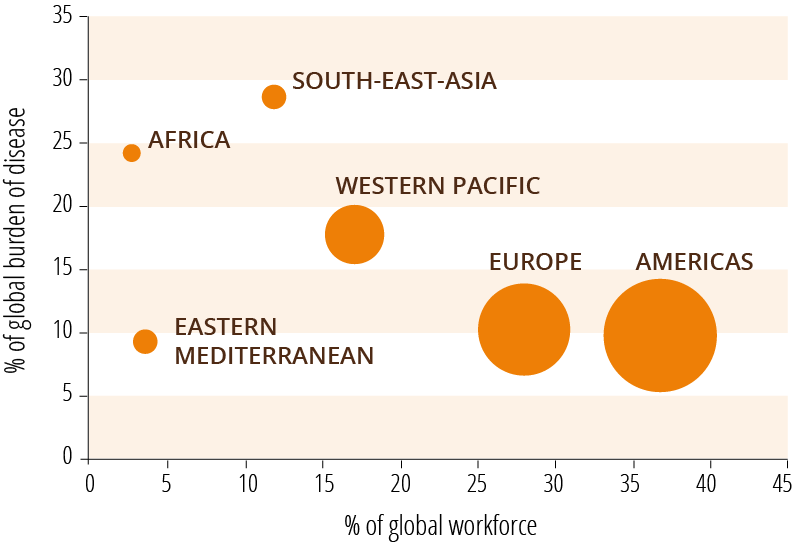
Cervical cancer control is further constrained by the broader health workforce crisis in sub-Saharan Africa. The region carries about 24% of the global disease burden but has only around 3% of the global health workforce and spends roughly 0.3% of global medical expenditure.
In sub-Saharan Africa, very low physician density and a severe shortage of specialists — including gynecologists, oncologists, pathologists, and radiologists — combine with limited radiotherapy and advanced cancer treatment capacity, leaving many countries with few or no radiotherapy machines. Overburdened staff and facilities make it difficult to add new services such as screening programs without disrupting existing care, making this workforce gap a fundamental barrier to scaling up cervical cancer prevention and treatment.
In many partner countries, health systems are already stretched by high burdens of infectious diseases:
Many cervical cancer prevention programs still rely on paper-based registers and fragmented medical records. This leads to:
To address this, ETiCCS collabarates with partners to develop electronic data systems that link communities, health facilities, and laboratories, enabling real-time results, better coordination, and stronger monitoring and evaluation.
What is the global burden of cervical cancer? See The Cervical Cancer Burden.
How does cervical cancer develop? Explore HPV, Precancer and Cancer.
What can be done to prevent it? Read about Cervical Cancer Prevention.

Department of Applied Tumor Biology
Institute of Pathology
Heidelberg University Hospital
Im Neuenheimer Feld 224,
69120 Heidelberg, Germany
Tel: +49 6221 56 4220
info@eticcs.org