
The global picture
Cervical cancer is the second most common cancer in women living in less developed regions, but in Kenya it is the most common cause of cancer-related deaths. Every year, over 500,000 women worldwide are newly diagnosed with cervical cancer.
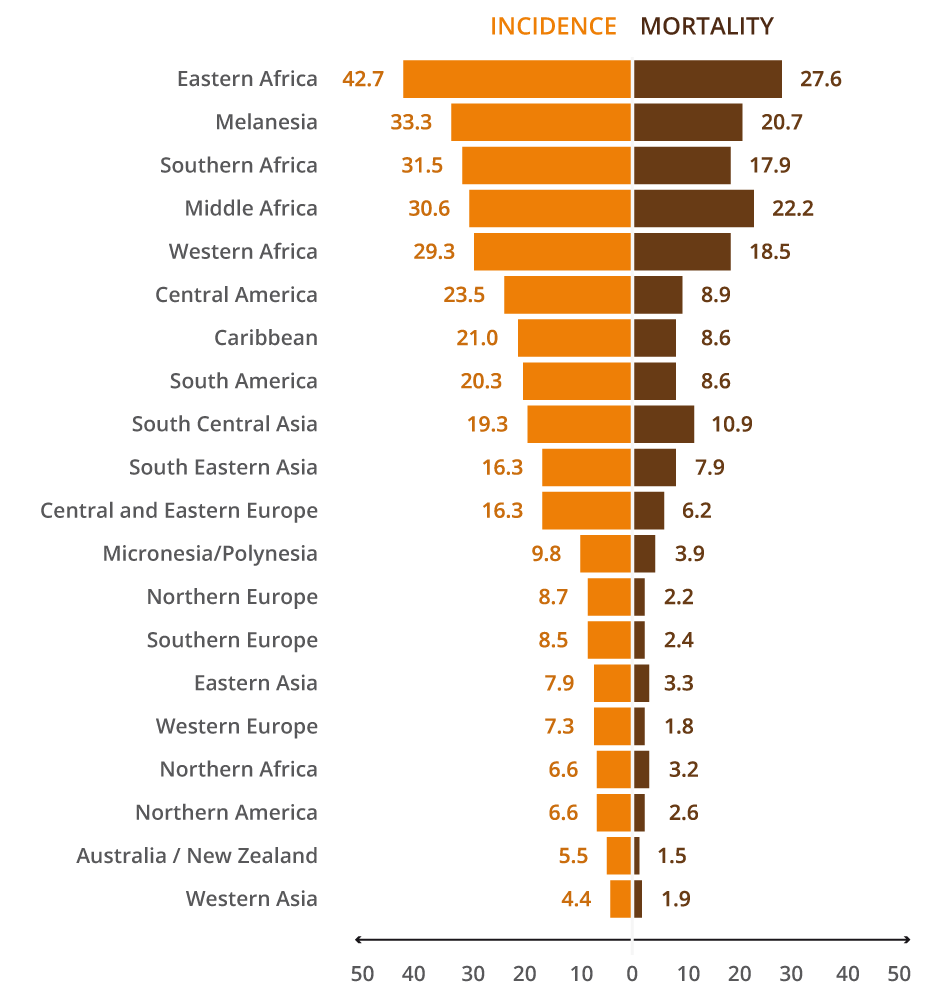
The age-standardized incidence rates for cervical cancer are highest in eastern Africa, averaging 42.7 per 100,000 women per year and reaching over 50 per 100,000 in some countries of sub-Saharan Africa, including Malawi (75.9/100,000) and Tanzania (54/100,000).
While cervical cancer incidence has fallen sharply in many high-income countries, it remains a leading cause of cancer death among women in low- and middle-income countries (LMICs). About 90% of cervical cancer deaths occur in LMICs, particularly in sub-Saharan Africa, South Asia, and parts of Latin America and the Caribbean.
Every 1.5 minutes a woman dies of cervical cancer — most of them in low- and middle-income countries.
Inequality in cervical cancer
Cervical cancer is a disease of inequality. Women who are poorest, have the least excess to education, and living in rural or marginalized communities face the highest risk of developing and dying from cervical cancer.
Key drivers of this inequity include limited access to HPV vaccination, screening, and timely treatment; weak health systems, long distances to clinics and social barriers such as stigma and low awareness.
As a result, women in sub-Saharan Africa face a lifetime risk of cervical cancer that is many times higher than in high-income countries.
Why this matters for ETiCCS
The unequal burden of cervical cancer is the core reason for ETiCCS’s work. Our focus is on settings where the gap between what is scientifically possible and what is actually available is largest and where innovative, scalable solutions can have the greatest impact.
By implementing evidence-based screening, triage, and digital health tools in low-resource settings, we aim to reduce this burden and move closer to the WHO goal of cervical cancer elimination.
Learn more
How does cervical cancer develop? See HPV, Precancer and Cancer.
What can be done to prevent it? Explore Cervical Cancer Prevention.
What stands in the way? Read about Challenges in Cervical Cancer Control.

Department of Applied Tumor Biology
Institute of Pathology
Heidelberg University Hospital
Im Neuenheimer Feld 224,
69120 Heidelberg, Germany
Tel: +49 6221 56 4220
info@eticcs.org